

Introduction
The study of biologically active compounds obtained from marine animals is a rapidly developing field of science, becoming interdisciplinary in nature [1].
Alkylglycerol ethers (AGEs) are precursors of plasmalogens, which are involved in the development of the nervous system and its normal functioning by regulating the release of neurotransmitters, as well as in the mechanisms of socially important neurodegenerative diseases such as Alzheimer’s disease [2].
We investigated the effect of AGE administration on animal behavior, hypothesizing that this effect might be evident, as these compounds showed good results in our experiments with acute and chronic stress [3-5].
Methods
AGE preparation
The magister armhook squids (Berryteuthis magister) were collected from the Bering Sea. Their digestive gland was frozen at -18 °C. We used all analytical-grade chemical reagents and solvents from Sigma-Aldrich (USA). AGEs were obtained according to the method by Ermolenko et al. [6].
AGE Analysis
The experimental substance contained 95% of chimyl alcohol (16:0 radical) and 5% of batyl alcohol (18:0 radical) by weight. To identify trimethylsilyl derivatives of AGEs (TMS-AGEs), we used GC and GC-MS [7]. The resulting AGE preparation was a white, odorless, free-flowing powder.
Animal treatment
We used male Wistar rats in the study. They were approximately 2–3 months old at the time of the experiment. Rats were maintained in a vivarium under natural light and on a standard diet. Before the experiment, rodents weighed 178±21 g and were weighed every 5-10 days. For 22 days, experimental animals (n=15) were force-fed with an aqueous suspension of AGEs at a dose of 200 mg/kg, while 15 control rats were given just water. The volume of administered fluid was approximately 0.5 mL.
At the end of the experiment, rats were anesthetized with isoflurane and euthanized.
Behavioral tests
The marble burying test was performed using nine marbles (2.5 cm in diameter) for 10 minutes. The experimental box measured 45 cm × 24 cm × 21 cm [8].
The Y-maze test measured the number of correct overlapping triplets (alternations), the total number of choices, and the number of errors (repeated choices of the same target) over 5 minutes. The spontaneous alternation rate was then calculated [9].
Statistical analysis
Statistical data were processed using Statistica 10.0 software. Normality of distribution was tested using the Shapiro-Wilk test. Data are presented as median, lower (25%) and upper (75%) quartiles, mean, and standard deviation from the mean. Student’s t-test and the Mann-Whitney test were used to compare groups.
Results
AGE administration at the chosen dose had no significant effect on rat body weight.
Differences between groups in the marble burying test were not statistically significant either at the beginning of the experiment or 8 days after the start of AGE administration (Figure 1). On Day 22 of the experiment, animals in the control group buried more marbles (on average, 3.2±1.5) than animals receiving AGEs (on average, 1.9±1.1), and the difference between the groups became statistically significant (t= -2.25; p=0.040).
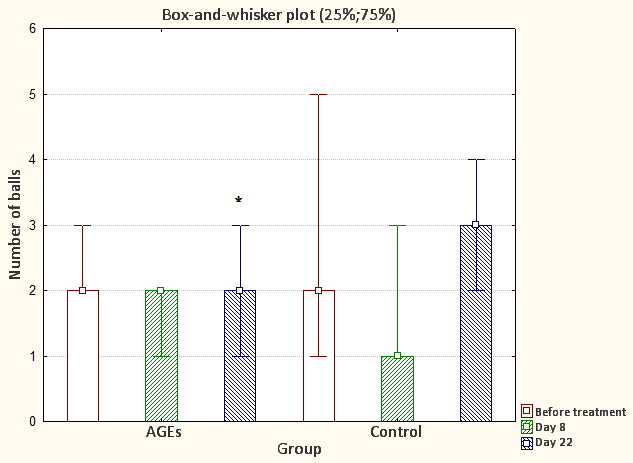
Figure 1. Marble burying test results.
* The difference between the control and experimental groups at the end of the experiment was statistically significant on Day 22 (p=0.040).
The results of the Y-maze test are presented in Table 1. No significant differences were observed between the control group and rats given AGEs.
Table 1. Results of the Y-maze test in rats
|
Parameter |
AGEs group |
Control group |
Statistics |
|
Number of errors |
0.27±0,47 0 (0-0.5) |
0.11±0.33 0 (0-0) |
Z=0.93; p=0.350** |
|
Number of regular overlapping triplets |
6.3±3,1 |
8.4±1.3 |
t=2.31; p=0.200* |
|
Total number of selections |
11.9±3.6 |
14.1±2.3 |
t=2.3; p=0.160* |
|
Spontaneous alternation rate |
68.7±14.2 |
70.4±8.3 |
t=2.31; p=0.560* |
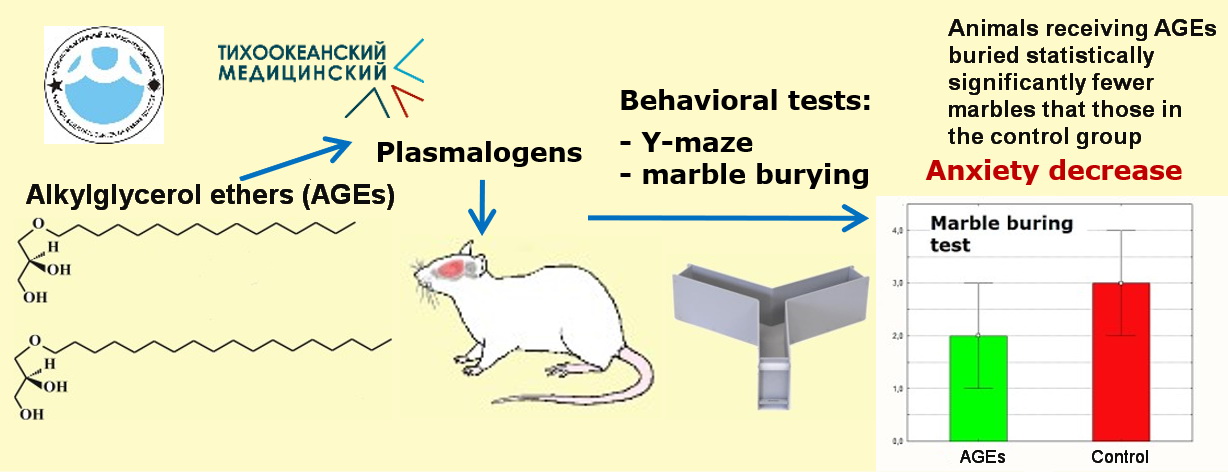
See General research design in Appendix 1.
Discussion
Plasmalogens regulate normal neural activity and the entire brain, preventing the development of dementia and neuroinflammation [4]. Taking into account our research on stress [3-5], we therefore, hypothesized that AGEs might improve behavioral patterns.
The Y-maze test has been described for assessing cognitive function [10], but it is also suitable for studying stereotypic behavior in rodents [11].
Rodents exhibit an innate preference for alternating movements when exploring a new environment. A marker of repetitive behavior is an increase in the percentage of animals choosing the same direction in the maze twice. In our study, the number of errors indicating repeated choices of the same arm did not differ statistically significantly between animals force-fed with AGEs and control animals.
The total number of choices reflects the animals’ activity in the Y-maze. This activity can be viewed as exploratory behavior or as a desire to find a way out of the maze to avoid a new or potentially dangerous situation. In the general behavioral profile of anxiety, the animals’ general motor activity is increased [12].
In our experiment, treatment with AGEs reduced the number of marbles buried by the end of the experiment. The effect observed by the end of the experiment (Day 22) was associated with the accumulation of plasmalogens in cells, the precursors of which are AGEs [3-5].
Results of the marble burying test can be used as an indicator of anxiety. However, the marble burying is more relevant for obsessive-compulsive disorders, as a form of anxious behavior, than for other anxiety states [13]. We view our results as a reduction in repetitive behavior associated with anxiety, which can be considered a favorable sign. The obtained results are preliminary and at this stage do not explain which specific form of anxiety is associated with the observed effect.
In 2024 [14], Jiang R. et al. reported that mice treated with diacyl glyceryl ethers (deep-sea shark liver oil) exhibited reduced anxiety and depressive behavior. Unfortunately, the authors did not take into account the complex component composition of shark liver oil, making it difficult to directly attribute the observed biological effect to AGEs, given that polyunsaturated fatty acids [15], squalene [16], vitamin A [17], and vitamin D [18] have already been confirmed to have anti-anxiety effects. Our approach is unique in that we use pure substances (AGEs), allowing for a more accurate assessment of their individual properties. Hence, we find our approach deserving scientific interest in terms of the potential of AGEs in treating anxiety
Conclusion and prospects
The effect of AGEs is more closely related to anxiety, particularly obsessive-compulsive behavior, than to memory. AGEs reduced anxiety levels in rats and, thus, increased their adaptation. Further research in this area may clarify the role and potential use of AGEs in anxiety mechanisms and further explore their role in neurodegenerative diseases. This opens the possibility of using this substance to reduce anxiety and other socially significant diseases in humans. The production of AGEs from readily available raw materials obtained from commercial fisheries facilitates their widespread use in maintaining and restoring health.
Ethical approval
This study was conducted in accordance with ARRIVE guidelines (https://arriveguidelines.org) and the Guide for the Care and Use of Laboratory Animals (8th edition, National Research Council, USA). The animal study protocol was approved by the Ethics Committee of the A.V. Zhirmunsky National Scientific Center for Marine Biology, Far Eastern Branch of the Russian Academy of Sciences (protocol # 04 of July 29, 2022).
AI statement
No artificial intelligence or AI-based tools were used in the preparation of this manuscript.
Funding
This study was supported by the Aqua Port, LLC (grant #0024/2025).
Acknowledgments
We thank Irina A. Barsegova for help in preparing this manuscript for publication.
Conflict of interest
The authors declare no conflicts of interest.
Appendix 1. General research design
- Stonik VA. Some results and new trends in the development of studies on marine biologically active metabolites. Pacific Med J 2016; (4): 16-18. Russian. https://doi.org/10.17238/PmJ1609-1175.2016.4.16-18.
- Dorninger F, Forss-Petter S, Wimmerb I, Berger J. Plasmalogens, platelet-activating factor and beyond – Ether lipids in signaling and neurodegeneration. Neurobiol Dis 2020; 145: 105061. https://doi.org/10.1016/j.nbd.2020.105061.
- Poleschuk TS, Sultanov RM, Ermolenko EV, Shulgina LV, Kasyanov SP. Protective action of alkylglycerols under stress. Stress 2020; 23(2): 213-220. https://doi.org/10.1080/10253890.2019.1660316.
- Sultanov RM, Ermolenko EV, Poleshchuk TS, Kasyanov SP. Alkyl glycerol ethers as adaptogens. Mar Drugs 2023; 21(1): 4. https://doi.org/10.3390/md21010004.
- Sultanov RM, Poleshchuk TS, Ermolenko EV, Kasyanov SP. Protective properties of marine alkyl glycerol ethers in chronic stress. Mar Drugs 2023; 21(4): 202. https://doi.org/10.3390/md21040202.
- Ermolenko EV, Latyshev NA, Sultanov RM, Kasyanov SP. Technological approach of 1-O-alkyl-sn-glycerols separation from Berryteuthis magister squid liver oil. J Food Sci Technol 2016; 53(3): 1722-1726. https://doi.org/10.1007/s13197-015-2148-x.
- Bordier CG, Sellier N, Foucault AP, Le Goffic F. Purification and characterization of deep-sea shark Centrophorus squamosus liver oil 1-O-alkylglycerol ether lipids. Lipids 1996; 31(5): 521-528. https://doi.org/10.1007/BF02522646.
- Llaneza DC, Frye CA. Progestogens and estrogen influence impulsive burying and avoidant freezing behavior of naturally cycling and ovariectomized rats. Pharmacol Biochem Behav 2009; 93(3): 337-342. https://doi.org/10.1016/j.pbb.2009.05.003.
- Hidaka N, Suemarua K, Takechi K, Li B, Araki H. Inhibitory effects of valproate on impairment of Y-maze alternation behavior induced by repeated electroconvulsive seizures and c-Fos protein levels in rat brains. Acta Med Okayama 2011; 65(4): 269-277. https://doi.org/10.18926/AMO/46853.
- Deacon RMJ, Rawlins JNP. T-maze alternation in the rodent. Nat Protoc 2004; 1(1): 7-12. https://doi.org/10.1038/nprot.2006.2.
- Campolongo M, Kazlauskas N, Falasco G, Urrutia L, Salgueiro N, Höcht C, et al. Sociability deficits after prenatal exposure to valproic acid are rescued by early social enrichment. Mol Autism 2018; 9: 36. https://doi.org/10.1186/s13229-018-0221-9.
- Kalueff AV, Tuohimaa P. Experimental modeling of anxiety and depression. Acta Neurobiol Exp (Wars) 2004; 64(4): 439-448. https://doi.org/10.55782/ane-2004-1526.
- Himanshu; Dharmila; Sarkar D; Nutan. A review of behavioral tests to evaluate different types of anxiety and anti-anxiety effects. Clin Psychopharmacol Neurosci 2020; 18(3): 341-351. https://doi.org/10.9758/cpn.2020.18.3.341.
- Jiang R, Ohkubo T, Sato T, Sakai N. Stress-easing effect of diacyl glyceryl ethers on anxiety-related behavior in mice. Foods 2024; 13(23): 3765. https://doi.org/10.3390/foods13233765.
- Mroczka M, Świtała K, Pysz P, Hrapkowicz R, Czernecka A, Erazmus K, et al. The role of omega-3 polyunsaturated fatty acids in prevention and treatment of mental health disorders – A review. Med Sci 2025; 29(161): e117ms3595. https://doi.org/10.54905/disssi.v29i161.e117ms3595.
- Sasaki K, Othman MB, Ferdousi F, Yoshida M, Watanabe M, Tominaga K, et al. Modulation of the neurotransmitter systems through the anti-inflammatory and antidepressant-like effects of squalene from Aurantiochytrium sp. PLoS One 2019; 14(6): e0218923. https://doi.org/10.1371/journal.pone.0218923.
- Zhang Y, Ding J, Liang J. Associations of dietary vitamin A and beta-carotene intake with depression. A meta-analysis of observational studies. Front Nutr 2022; 9: 881139. https://doi.org/10.3389/fnut.2022.881139.
- Wen Z, Bai L, Wu S, Chen J, Jama HA, Sawmadal JD. Association of serum vitamin D with anxiety in US adults: A cross-sectional study. Front Nutr 2024; 11: 1371170. https://doi.org/10.3389/fnut.2024.1371170.
Received 14 January 2026, Revised 20 April 2026, Accepted 30 May 2026
© 2026, Russian Open Medical Journal
Correspondence to Tatiana S. Poleshchuk. Phone: +79089659300. E-mail: tat_s82@mail.ru.